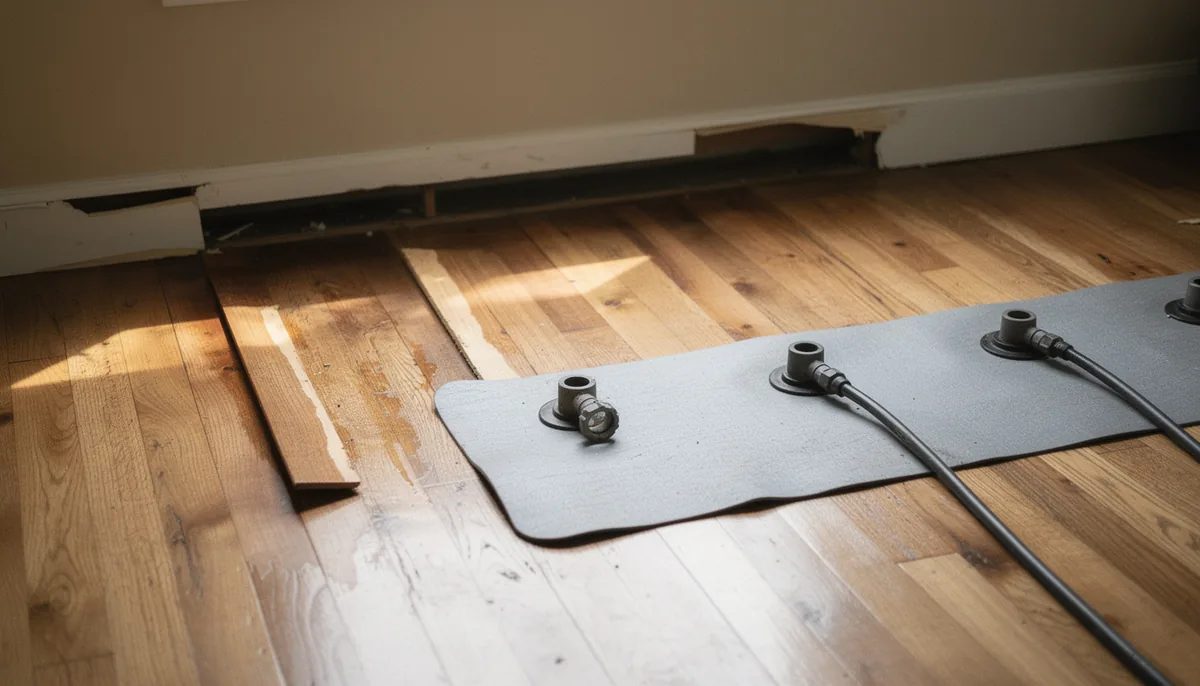
Can water-damaged wood be saved? Often it can, and sometimes it cannot be saved at any price. The answer turns on what kind of wood it is, how long it stayed wet and what kind of water it sat in. Solid hardwood and the studs inside a wall tend to come back when they are dried properly. Laminate, particleboard and the swollen bottom of a vanity rarely do. This guide goes through the wood in a typical South Bay house, from the floor to the cabinets to the framing, and explains what decides whether each one stays or goes, so the call in your written scope makes sense when you read it.
Material, Time and Water Type
The material comes first. Solid wood is dense and can give up water slowly without falling apart. Products made from glued wood fibers or chips, such as laminate cores, MDF baseboard and particleboard cabinet boxes, swell when they get wet and do not shrink back.
Then there is time. Wood that has soaked for days is harder to dry, more likely to warp and more likely to grow mold on its surface. A leak caught the same morning leaves a lot more options than one found after a weekend away.
The type of water can override both. Under the industry's category convention, wood that soaked in sewage or outdoor floodwater is judged differently from wood wet by a clean supply line. Porous material that touched Category 3 water is removed as a matter of practice, while sealed hard surfaces can often be cleaned and kept. Sorting all of this, piece by piece, is the first job of water mitigation, and it happens before any drying equipment is set.
Solid Hardwood Floors
Solid hardwood is the most salvageable floor in the house when the crew gets to it early. The usual method is floor drying mats, flat panels laid over the boards and connected to equipment that pulls moisture up through the wood under controlled suction. The boards are metered each day so they are not dried too hard, which can crack them.
Wet hardwood often cups, with the edges of each board higher than the middle, because the bottom of the board took on more water than the top. Cupping can relax as the boards dry. The mistake to avoid is sanding a cupped floor flat while it is still wet, since the boards may crown, with the middle higher than the edges, once they finish drying. The EPA's water damage cleanup table also cautions against applying heat to hardwood floors.
Dense materials like hardwood, plaster and concrete are treated as a slower drying class under the IICRC S500 standard, so a hardwood floor tends to take longer than the carpet and drywall in the same house.
Laminate, Engineered Wood and Vinyl Plank
Laminate is the floor that almost never comes back. Its core is compressed fiberboard, and once water reaches the edges, the core swells and the joints peak. It is removed in nearly every real water event.
Engineered wood sits in between. The top layer is real wood over a plywood or fiberboard base, and how it fares depends on that base and how long it was wet. Plywood bases can sometimes be dried, while fiberboard bases behave like laminate.
Vinyl plank holds up to water on its face, but water that runs under it gets trapped against the slab or subfloor. The planks may survive, and they often still have to come up so the floor underneath can dry.
Cabinets and Vanities
Lower cabinets hide water. It gets in through the toe kick at the bottom front and soaks the cabinet base, and the damage is out of sight until the bottom shelf swells or the face frame separates. Most builder-grade cabinet boxes are particleboard, and particleboard that has swollen does not recover. Plywood boxes have a better chance.
The check is a moisture meter at the toe kick and on the back panel. A cabinet that reads wet often needs the toe kick pulled so air can reach underneath, or the whole unit removed so the wall behind it can dry. That means a plumber disconnects the sink first. Countertops can sometimes be lifted and saved, which matters with stone. If the cabinets have to go, ordering and fitting replacements is often the longest part of the job. When you compare companies for water damage repair, ask each one whether new cabinets are part of its scope or handed to another contractor.
Subfloor, Framing and Trim
Wall studs and floor joists are solid lumber and usually dry in place with air movement once the drywall and insulation around them are open. A bottom plate that sat in clean water for a short time typically reads dry again within the normal drying window. Plywood subfloor in a second story, common in two-story homes like many in Eastlake and Otay Ranch, can often be dried too. OSB subfloor is less forgiving and may swell at the edges.
Staining on framing is cosmetic once the wood reads dry. Mold is the bigger question. The EPA's guide to mold and moisture notes that a moldy area smaller than about 10 square feet can often be handled by the homeowner, and larger growth is cleaned before the walls are closed. MDF baseboard and casing that swelled are replaced, since trim costs little next to the time spent trying to save it.
Frequently Asked Questions
Can water-damaged hardwood be refinished instead of replaced?
Often, once it is fully dry. Boards that cupped and then flattened as the moisture evened out can usually be sanded and refinished. Boards that split, buckled off the subfloor or stayed wet long enough to stain dark are more likely to be replaced, and a meter reading decides when sanding can start.
Will cupped hardwood floors flatten after drying?
Many do, at least partly, as the moisture under the boards evens out with the top. That is why floors are dried and metered first and sanded only once readings are back to normal. Sanding a cupped floor while it is still wet can leave it crowned, with the middle of each board higher than the edges.
Can swollen particleboard cabinets be fixed?
Usually not. Particleboard that has swollen at the base keeps its new shape after it dries and loses strength, so the box is replaced in the rebuild. Plywood cabinet boxes have a better chance. A meter at the toe kick and back panel shows how far the water reached before anyone decides.
Is a wet subfloor ruined?
Not necessarily. Plywood subfloor that got wet with clean water and was dried promptly often survives, and it is checked with a meter before the new flooring goes down. OSB is more likely to swell at the edges, and any subfloor that soaked in sewage or stayed wet long enough to grow mold is cut out and replaced.
Ready to Get Started in Chula Vista?
Chula Vista Restoration Co. serves Chula Vista and the surrounding area. Get a free, no-obligation quote today.